Showing posts with label Volkswagen. Show all posts

Test Drive and Review of New Skoda Rapid


Design and Engineering
new skoda rapid
The VW Group is serious about deploying its diverse portfolio of brands in India. Keen to leverage economies of scale that come with such a strategy, the question VW and Skoda must have asked themselves is why make two specially engineered compact saloons when you can make do with one? Why indeed? And so what was born was the Vento, basically a stretched version of VW Polo, with a boot tagged onto the rear. Ideal for emerging markets like India, Russia, Brazil and future markets like China and Malaysia, this relatively compact saloon delivers mid-sized luxury for small-car money; in short, exactly what Indian customers want. What we have here isn’t the Vento however, but its near-Siamese twin, the Skoda Rapid, possibly the most Volkswagen-like Skoda ever. Sure, VW and Skoda  share platforms and engines, but their cars differ considerably too. The Fabia is a completely different car from the Polo; the Jetta has very little in common with the Laura and the same holds true for the Superb and Passat as well. In comparison, you could justifiably call the new Rapid a ‘badge-engineered’ Vento, and you wouldn’t be too far off the mark.
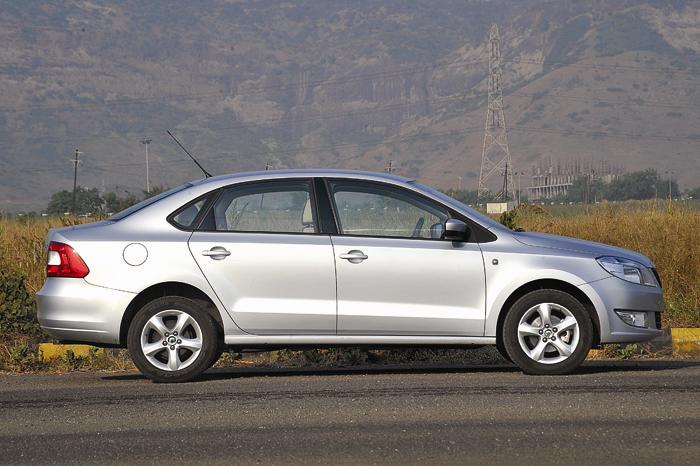
new skoda rapid side view
So, under the skin the Rapid is a VW Vento. Which, of course, means it has the same long 2552mm wheelbase, the same 1699mm width and the same widened front and rear track. The Rapid, however, is marginally longer than the Vento, but that’s just down to the larger nose of the Skoda. Also identical is the suspension the Skoda uses; MacPherson struts up front and non-independent coil springs in the rear. And the brakes and steering system are identical too. Skoda however has tuned each of these components a bit differently which, as we will see later, makes this car drive quite differently from the Vento.
The Rapid may look at first like a Vento with a Fabia nose stuck on it, and in a way it is, but the Skoda looks much more attractive in the flesh. The large nose balances the elongated body nicely; Skoda designers have done a fabulous job of seamlessly merging some of the disparaging lines. The new larger fenders and mildly altered chin complete what must have been a difficult styling exercise. While the flanks of the car remain the same, down to the use of an identical mirror, Skoda has altered the boot-lid, taillights and rear bumper too. But the changes are so subtle; you’ll only spot them if you look hard.

Interior
new skoda rapid interior view
The cabin, like the exterior, is derived from the Vento with plenty of Skoda overtones. The basic architecture of the dash is the Vento’s and the simple layout, slender central console and the large glove-box with the poor-fitting lid are all shared. Also carried over unaltered from the VW are the headlight switch, climate control, and the low quality air-con vents that, as we’ve found, have a tendency to break easily. And the seats are identical too. The front seats have good bolstering and thigh support, making them comfortable on long drives, the steering can be adjusted for height and reach and the driver’s seat can be raised and lowered too. So finding a good driving position is easy. The Rapid however comes


with slightly coarser seat fabric and some missing chrome highlights, such as the ones found around the VW’s vents.


There are plenty of Skoda parts on the inside though, and these change the character of the cabin quite a bit. Skoda’s chrome-lined steering wheel looks and feels good, the gearlever is similar to the one on the Fabia, the instrument panel comes from the Czech Republic rather than Germany and there is a Skoda audio system as well. Unlike VW, which uses a deep shade of brown, Skoda uses black for all these bits and that does cause some amount of dissonance in the cabin. Still, if you are not familiar with the Vento, you’ll find that these Skoda parts actually blend surprisingly well. Except for the gearlever, which looks like the chrome has been added as an afterthought.


With its extended wheelbase and additional width, the rear seat of the Rapid is also a good place to be. There’s plenty of legroom, the seat is wide and you get a nice airy feel when sitting in the rear. And the seat is reasonably comfortable too. You climb out feeling fresh even after a long drive and this is also true if you are tall. But it could have been nicer. You sit a bit low, the backrest is a bit vertical and there is that huge tunnel in the centre of the cabin, which makes it difficult to get in and out if you are the third passenger in the back. Still, like the Vento, you get the large rear air-con vent and that clever lever that allows you to push the front passenger seat forward.


The Rapid is sold in three variants — Active, Ambition and Elegance. The Active gets body-coloured bumpers, central locking, power windows and air-conditioning. The Ambition adds ABS, driver airbag, remote locking and driver’s seat height adjustment. The Elegance, the one you see here, has alloy wheels, climate control, a CD player with aux-in, electrically adjustable mirrors and a front passenger airbag. 


Engine and perormance

new skoda rapid technology
Power to the Rapid’s front wheels comes from a pair of 105bhp, 1600cc motors, shared with the Vento. While both the petrol and diesel make the same amount of power, it’s the common rail diesel’s extra 10kgm ◊ ∆ of torque that makes it the more effortless of the two. It’s also tuned slightly differently from the VW, and initial progression is smoother and more immediate. Throttle responses are relatively crisp, the motor revs more easily from medium engine speeds and there seems to be more punch in the mid-range. So driving in traffic is really much nicer, with only some turbo-lag present. The Rapid also lacks that big spike in power you get on the diesel Vento, and this makes it even nicer in traffic. You do miss the thrill of that sudden burst of power and the Rapid doesn’t pull as willingly at the top of its powerband, but we still found it to be just as quick. It matches the Vento to 100kph and by 140, it’s even ahead.

Skoda has made the petrol version better to drive as well. The 1.6 Mpfi engine isn’t the most modern motor around and doesn’t feel as light and responsive as some of the Japanese units. Still, with shorter gearing and altered tuning, we could have sworn that there was a different engine under the hood. It’s slightly boomy at some points in the powerband, and it moans a bit near the 6200rpm redline as well, but the petrol Rapid still feels better to drive. It’s faster to respond to a tap on the throttle, it pulls slightly harder throughout the rev range and pedaling this car quickly is actually enjoyable. The Rapid is considerably quicker than the Vento in a straight line with 100kph reached approximately one second quicker. It’s still not close to the City though, the performance king of the segment almost three seconds quicker to 140kph.

VW has always made some of the nicest manual gearboxes, and this one is no different. It is light to use, the throw is short and this makes it one of the slickest boxes around. 

Verdict
new skoda rapid back light
From the outside, the Rapid looks like nothing more than a VW Vento with a Skoda nose and Skoda badges. And that's what it undeniably is. However, dig deeper and Rapid proves to be much more than a Volkswagen clone. Yes, some of the shortcomings of the Vento remain. These are not the most refined cars to come out of Planet VW, the Rapid doesn't seem to adhere as closely to global build quality standards as something like a Fabia and this car is still nowhere as well equipped as some of the competition. However, on the plus side, Skoda has ironed out many of the Vento's other shortcomings. The diesel engine is more linear but just as punchy, the shorter geared petrol now works much better and ride and handling are much improved as well. Spacious, fast, frugal, reasonably well-built and good value, the Rapid has a lot going for it. We're going to see a lot of them.


Tech Specs

new skoda rapid rear view
From the outside, the Rapid looks like nothing more than a VW Vento with a Skoda nose and Skoda badges. And that's what it undeniably is. However, dig deeper and Rapid proves to be much more than a Volkswagen clone. Yes, some of the shortcomings of the Vento remain. These are not the most refined cars to come out of Planet VW, the Rapid doesn't seem to adhere as closely to global build quality standards as something like a Fabia and this car is still nowhere as well equipped as some of the competition. However, on the plus side, Skoda has ironed out many of the Vento's other shortcomings. The diesel engine is more linear but just as punchy, the shorter geared petrol now works much better and ride and handling are much improved as well. Spacious, fast, frugal, reasonably well-built and good value, the Rapid has a lot going for it. We're going to see a lot of them.
Overall Rating  
new skoda rapid rating


Toyota confirms Etios one-make series for 2013


toyota etios auto expo
Toyota has formally launched its Indian motorsport effort under the moniker ‘Toyota Motor Racing’ by unveiling the race-prepared Etios and Liva at the Auto Expo. Although the series was widely expected to kick off this season, Toyota plans to launch the full-fledged series only in 2013. However, a few exhibition races will be held in 2012, with the opening event just three weeks away on January 28 to be held, surprisingly, in Chandigarh. Since the city doesn’t have a purpose-built racing circuit, it is safe to assume that the race would be held on a temporary street circuit. The main series, however, will focus on the three race tracks in India - the Buddh International Circuit, the Madras circuit and the Kari Speedway in Coimbatore.

A tentative grid of 25 cars will be made up of drivers aged between 15-24 years with a multi-tiered selection process. Step one for racing aspirants would be to apply online, with entries opening January 15 and closing on February 15. Basic training camps will follow in March and June with the applicants being shortlisted based on their performance. The shortlisted lot will then go through simulator and karting evaluations before getting behind the wheel of the Toyota race cars. The final 25 will be selected and trained by specialised coaches using Toyota’s global racing curriculum.

To make the Etios and Liva cars race-worthy, both cars will undergo modifications with the process being well underway at the Red Rooster Racing facility in Bangalore. The proximity to Toyota’s Bidadi plant is no coincidence, and the process is being supervised by Toyota. Apart from the usual myriad of safety-related and aesthetic modifications, the 1.2- and 1.5-litre engines will be massaged to release more horsepower with performance suspension and wheels headlining the dynamics department. Toyota is expected to partner with MRF Tyres as the official tyre supplier for the series, drawing parallel with the only other manufacturer-backed one-make series, the JK Tyre-Volkswagen Polo Cup.

Volkswagen reveals Cross Coupe concept

Volkswagen has showcased an all-new SUV concept at the Tokyo Motor Show. Known as the Cross Coupé concept, it hints at design themes of all future SUV’s from Volkswagen stable.
The Cross Coupé previews the bold new look of its Volkswagen’s second-generation Tiguan compact SUV. Sitting on
the German carmaker’s versatile new MQB platform, the new four-seater, four-wheel drive petrol-electric hybrid is officially described as a cross between a four-door coupé and compact SUV, which has led many to speculate that Volkswagen is considering a second compact off-roader model in the mould of the Range Rover Evoque.
However, Volkswagen sources close to design boss Walter de Silva have confirmed to Autocar that the Cross Coupé has a broader brief in previewing a new design lineage that will be adopted by all of the company’s upcoming SUV models, including the next Tiguan due out in 2014.
“We won’t rule out the possibility of adding a sportier SUV to the Volkswagen line-up at some time. But the main message with the Cross Coupé is its styling, which stands for the future of SUV design at Volkswagen,” Autocar was told.
The Cross Coupé combines front-end styling elements first seen on the Tex and Go concepts, penned by Volkswagen-owned Giugario, wheeled out at the Geneva motor show earlier this year, with heavily sculptured surfaces throughout. It has a highly defined shoulder – or ‘tornado line’ as de Silva refers to it – higher waistline, shallow side glass, heavily angled tailgate, distinctive wheel arch design and 20-inch alloy wheels shod with substantial 265/45 profile tyres.
The five-door Cross Coupé is both considerably bolder than the current-generation Tiguan, whose design dates back to 2005 and a former Volkswagen design team headed by Murat Gunak.
Volkswagen has provided its latest concept with a classy Audi-esque cabin, with a sweeping dashboard whose various horizontal design elements mirror those of the exterior, and a hi-tech instrument display combining traditional analogue and the latest in computer-enhanced graphics. It also has grab handles incorporated into the centre pod and four heavily contoured seats separated by a high-set centre tunnel which is used to store a battery that powers the concept’s electric motors.
At 4345mm in length, 1868mm in width and 1523mm in height, the Cross Coupé is 125mm shorter, 58mm wider and a significant 177mm lower than today’s first-generation Tiguan. It also rides on a wheelbase that is 26mm longer at 2630mm – allied to tracks that up by 15mm at the front and by 43mm at the rear at 1585mm and 1613mm respectively. Nominal boot space underneath the rear windows is put at 380 litres – or 90 litres less than the Tiguan, rising to 1230 litres when the rear seats are folded away.
Powering the Cross Coupé is a petrol-electric hybrid system capable of providing drive to either the front wheels or all four wheels via a seven-speed, double-clutch gearbox, depending on the driving conditions. It combines Volkswagen’s familiar turbocharged 1.4-litre, four-cylinder, direct-injection TSI petrol engine producing 148bhp and 21.4kgm of torque with a pair of brushless electric motors – one sited up front delivering 54bhp and 18.3kgm and a larger one at the rear with 114bhp and 27.5kgm. The system is calibrated to provide a maximum 261bhp.
Energy for the electric motors is supplied by a battery mounted low down within the centre tunnel of the floorpan. Rated at 9.8kWh and operating at a maximum 370 volts, the lithium ion unit can be charged both on the run through the recovery of kinetic energy (both on a trailing throttle and under braking) and via plug-in means with conventional mains power.
Volkswagen claims an all-electric range of 40km at typical city speeds in front-wheel drive mode, at which a clutch is actuated to disconnect the petrol engine from the drive process when there is sufficient battery charge.
In a move aimed at reducing weight, Volkswagen has replaced the conventional mechanical driveshaft with a newly developed electric driveshaft that sees the rear wheels driven exclusively by the rear electric motor. In four-wheel-drive mode, the rear electric motor is fed electrical energy from the front electric motor, which then acts as a generator powered by the petrol engine. All up, the new concept car is claimed to weigh 1748kg – 128kg more than the heaviest of today’s Tiguan models, the 2.0 TDI, distributed 58 percent to the front axle and 42 percent to the rear.
Despite its relative weight, Volkswagen claims a 0-100kph time of just 7.0sec – placing the Cross Coupé 0.8sec ahead of the most powerful Tiguan model of today, the 2.0 TSI, in outright straight-line performance.
Top speed, however, is capped at just 200kph on a combination of petrol and electric power or 115kph when relying on electric power alone.

Petrol Ventos, Mercs for a steal


The Mahindra First Choice Super Store at Goregaon, Mumbai, has on offer six 1.6-litre petrol VW Vento Autos for Rs 7.75 lakh each. Manufactured in the year 2011, these cars have only clocked 2800-12000km on the odo, and are still under factory warranty.
Also on sale is a 2008 VW Passat diesel for Rs 12.50 lakh and an October 2009 Jetta that has been driven 23,000km for Rs 12 lakh. In the premium segment, there are two BMW 3-series’ – a 2008 320i for Rs 16 lakh and a 2010 320d for Rs 26 lakh. The Mercs on offer include a 2011 Mercedes E350 petrol priced at Rs 40 lakh, a 2010 C200 retailing for Rs 20 lakh and a 2002 E240 at Rs 12.50 lakh.
All these cars come with a one-year First Choice 24/7 road-side assistance service.

2011 VW Jetta review, test drive


At first glance, you may think this is the VW Vento, but upon closer inspection you will realise that it is the all-new Volkswagen Jetta. For a car that’s making a fresh start, to be likened to its cheaper sibling can’t be a good thing. But there’s an upside too, VW has unified the look of all its latest-generation models. It’s also easy to mistake the Jetta for the bigger and more expensive Passat, which shares the same styling lineage.
The new Jetta really looks far removed from the model it replaces. The bland, rounded shape and soft contours are replaced by crisper (but equally bland) horizontal lines. The nose is the most interesting bit of the car with its wide, horizontal grille, angular lamps and a tray-shaped ‘splitter’. The overall styling is best defined as a clean and uncluttered.
The new car has grown in every dimension; it is now 90mm longer than its predecessor and gets an extra 58mm in the wheelbase, which hints at the best-in-class interior space. Despite all the extra sheet metal, the new Jetta weighs just 25kg more than before.
Step inside the Jetta and it feels like a mini-Passat, more than a grown up Vento with top-notch plastics, and exemplary fit and finish. The chunky steering wheel feels great to hold. The steering-mounted buttons are small but have a wonderfully tactile feel. The air-con vents feel solid too and the overall heft of the dashboard and door pads reveal the durable build of the car.
The new Jetta is better specced too, but the small details that made the previous Jetta special are missing. The driver gets a 12-way power adjustable seat, including lumbar support, and finding the perfect driving position is easy. The front seats are generous but a touch flat and you get synthetic fabric instead of leather seats. The top-of-the-line Highline variant gets eight airbags, while the Trendline and Comfortline variants get six.
The most glaring oversight in the new Jetta is the missing dual-zone climate control. Instead, it gets a simple air-con unit and though it’s still electro-mechanically controlled, there isn’t even a digital temperature readout. To make up, VW has given the Jetta other goodies like iPod connectivity, Park Distance Control with display on the central infotainment system, and daytime running headlights.
Moving to the rear, this VW has the most comfortable backseat we have seen in any Rs 15-20 lakh car. The ‘hip-point’ is nice and high so you sit more relaxed, legroom is class-leading and the seat base is generous and superbly contoured. If there is a fault, it’s with the cushioning which is a touch too hard and the backrest that’s a wee too upright. The rear seats now get an armrest and a 60:40 split. The boot capacity is a good 510-litre.
Under the hood, the 1986cc, 108bhp motor has been replaced by the 138bhp version of the same turbo-diesel engine. For the moment, VW is offering the new Jetta with just this single diesel engine which comes with six-speed manual and automatic options. There is no petrol option yet, but we understand a 1.4 TSI version is expected sometime in 2012.
The diesel motor is not the quietest of motors and though it’s not really intrusive you can’t miss its characteristic gruffness, especially at higher revs. There’s minimal turbo-lag and we just love the strong tug you get from low revs. Performance is more than adequate and there’s always a surplus of power and the swathe of torque, most of it low down in the rev range. But the DSG gearbox can make tight overtaking a tricky affair as well. There’s a huge delay in power delivery when you floor the throttle and then suddenly the car just takes off.
The way to work around this is to drive in manual mode which, apart from being good fun (the paddle-shifters feel terrific), keeps the engine in the right cog for instant overtaking. The six-speed manual is slick and precise like before but it’s mated to an engine that doesn’t like to be revved hard.
On the twisty roads, the new Jetta’s safe and benign handling was immediately evident. The steering, though accurate and well weighted, is rather numb and doesn’t bristle with feel. The gentle responses and the leisurely manner in which the Jetta turns into corners doesn’t make it overtly sporting.
The ride is again fantastic and the Jetta dispatches bumps with ease. The suspension feels a touch more damped than before. However, on bad roads at low speeds, you can distinctly feel the underlying firmness in the suspension. But the ride is never uncomfortable.
VW has priced the base Trendline at Rs 14.12 lakh (ex-showroom Delhi), but as you move up to the Highline DSG which costs Rs 3.74 lakh more, the Jetta appears a bit pricey. But, if money isn’t the primary factor and what you want is a comfortable, well-built executive saloon with a bit of class, there’s nothing that fits the bill as well as the new Jetta.


2012 Volkswagen Phaeton

Specifications prices Modifications and Image 2012 Volkswagen Phaeton
At the Transparent Factory in Dresden Volkswagen produces one of the finest automobiles in the world: the Volkswagen Phaeton. The limousine's quality and comfort (four-wheel drive and air suspension as standard) set a unique benchmark. Volkswagen, the most successful carmaker in Europe and China, has now made the VW Phaeton even more perfect. The company's new flagship was unveiled for the first time at Auto China 2010 in Beijing.
Its contours are defined by the Volkswagen design DNA developed by Walter de Silva, the group's Italian chief designer. Around the completely new front section in particular the design team has further refined the model's very own stylistic aplomb. In the process the timelessly elegant Volkswagen Phaeton has gained a broader and more powerful appearance. The new model is also characterised by modifications to its rear section and silhouette.
At the same time, new technical features have been added. These include Dynamic Light Assist (camera-based dynamic main beam regulation) and a navigation system that, if desired, can integrate online data from Google into the map display. In addition to this, the Volkswagen Phaeton's optional front camera enables it to 'see' road signs, with speed limit signs visualised on the instrument panel and centre console's touchscreen. The system will also be able to recognise and depict 'no overtaking' signs - the first in the world to do so!
 INTERIOR
The VW Phaeton's interior ranks as one of the most elegant, high quality and comfortable in the entire premium class. The 4-zone air-conditioning system, for example, that works totally free of any draughts, and the award-winning ergonomic 18-way seats are unsurpassed. All of the Volkswagen Phaeton interior's functions are also intuitive to use. In addition to the version with three rear seats (5-seater), the limousine can be optionally ordered with two electrically adjustable individual seats (4-seater). Furthermore a version of the Volkswagen Phaeton is also available that is twelve centimetres longer. Meanwhile, the limousine can be almost infinitely personalised with a wide range of leather, alcantara and wood trim, plus optional equipment such as a fridge or multimedia systems from Volkswagen Exclusive. This also applies to the completely redesigned multifunction steering wheel. It can be ordered either in leather or in a wood/leather combination matching the relevant wood trim features.
EXTERIOR
Depending on wheelbase, the 2011 model VW Phaeton is between 5.06 and 5.18 metres long. As mentioned above, a completely new front section has been developed for this flagship of the Volkswagen brand. In keeping with the current Volkswagen design DNA, its form is dominated by horizontal lines. Unlike all other Volkswagens created to date on the basis of this new DNA, the Volkswagen Phaeton does not have a shiny black radiator grille cover, but instead a completely new chrome element. Along with the likewise restyled headlights, this radiator trim is a major influence in the new Phaeton's design and underlines its uncompromisingly independent character. In detail the new grille is more upright, while its stricter lines and impressive alternation of materials between polished and matt chrome make it even more striking. The horizontal linking of grille and headlights follows the Volkswagen design criteria and impressively emphasises the vehicle's width. As a sign of its class specific to this model the Volkswagen Phaeton also features three-dimensional moulding of the grille and bonnet, with precise edges that carry the grille's heightened expression of quality on into the sculptured contours of the vehicle body. Once again in the centre of the grille is the classic VW badge, which now - despite integrating the ACC (automatic distance control) system's radar sensors - has a new-look surface design.
To the left and right of the grille are new Bi-Xenon headlamps, which are standard across the range. Integrated within them are cornering and adaptive lights. Not just in visual terms, but from a technical perspective too, this is a whole new generation of headlamps. Firstly, the indicator and adaptive cornering lights are highly visible and stylistically striking LEDs. Secondly, as with the new Touareg, the VW Phaeton will also be available with optional Dynamic Light Assist. Using a camera integrated into the rear-view mirror, this complex technology 'detects' other road users and regulates illumination of the carriageway accordingly (see separate section on Dynamic Light Assist).
The bumper has also been redesigned in keeping with the radiator grille and headlamps. Here too horizontal lines form the guiding principles of the new design. Even the fog lamps have been designed as narrow, horizontal LED strips. Last but not least, the bottom final section of the bumper is now also colour-coordinated with the car body. Compared to the previous model the new generation Phaeton thus looks even sportier and more imposing on the road.
Also modified, the back of the car underlines this impression. The design team decided here not to change the classic, clear and powerful basic style that this area has always had, but instead to develop new LED rear light clusters. Each cluster features dotted lights and an M-shaped LED strip. The result is an unmistakable, elegant look both in daylight and at night. Also new is the VW badge - now likewise in 3D format - on the boot lid.
As at the front, the rear bumper has also been redesigned. It now has a new, three-piece chrome bar and the section of the bumper trim near the road is now also colour-coordinated with the car body. The same goes for the bottom section of the side skirts. Also noticeable in silhouette view are modified side trim strips, narrower LED indicators in the wing mirrors and new 18-inch ('Experience') alloy wheels.
 ENGINE
Powertrain options in the Phaeton remain unchanged. The lone diesel choice is a 240-hp, 3.0-liter V-6, while the gas-powered camp gets the choice between a 280-hp, 3.6-liter V-6, a 335-hp, 4.2-liter V-8, or a 450-hp, 6.0-liter W-12. Interestingly, the Phaeton does not see the updated, 500-hp, 6.3-liter W-12 from the new Audi A8. While the updates include no mention of the Phaeton returning to the U.S., we have heard from several high-placed executives that a comeback is being considered, likely after the next generation arrives in a few years. 
The W12 Phaeton’s 18-way memory power front seats are heatable, ventilated and have a 10-minute massage function and four-way power lumbar support. Rear seats also are heated. Interior trim on seating, steering wheel and doors includes premium wood, leather upgrades, and brushed metal accents.
As with all Volkswagen vehicles, concern for safety is uppermost in Phaeton. As standard safety equipment, both the V8 and W12 models have eight airbags, including Volkswagen’s Side Curtain Protection®; a four-wheel Anti- lock Braking System with emergency brake assist; electronic park assist; an advanced Electronic Stabilization Program (ESP®); and a tire pressure monitoring system.
source:www.netcarshow.com,www.caranddriver.com

2011 Volkswagen Touareg 2

Specifications prices Modifications and Image 2011 Volkswagen Touareg 2
The second generation of Volkswagen’s full sized SUV, the VW Touareg has made its first appearance on the internet, before we actually see the new car in flesh this March at the Geneva Motor Show. Aside from the revised exterior styling, the new Touareg will be the first and only off road capable vehicle in Europe built by a German car maker to be offered as a hybrid when it goes on sale this April.
INTERIOR
The Touareg's interior features are high on quantity and quality. While reviewers used to find the button-heavy dashboard confusing, the controls and systems inside the redesigned 2011 model are more intuitive. All models come with a seven-inch widescreen display between the main gauges.
Volkswagen has not released specs on the new Touareg, but all trims are expected to come with a navigation system – a rare standard feature even in a luxury SUV. Reviewers really like the system because it displays maps and directions in a three-dimensional view. The navigation system also comes with a 60-Gigabyte hard drive and satellite radio.
 EXTERIOR
The new Touareg is a much more elegant SUV thanks to the addition Volkswagen’s new "design DNA" that includes touches like a leaner more athletic body featuring more horizontal lines on the front end as well as distinctive headlights that give the new Touareg an unmistakable appearance at night; and will be offered with a choice of FSI V6, TDI V6 and V8 as well as a hybrid version that replaces the old gas burning V8 mill for most markets. The hybrid versions combines a high voltage electric motor with a direct injected gas burning supercharged TSI V6 cranking out 333 HP, like in the S4, and an 8 speed automatic transmission that gets nearly 29 MPG and is able to operate under battery power alone as a Zero Emissions Vehicle up to 31 MPH.
ENGINE
The new Touareg Hybrid comes with a 3.0-liter supercharged V6 engine paired with an electric motor. The powerplant makes a combined total of 375 horsepower and 428 pound-feet of torque. The Touareg’s other two engines are carryovers from 2010. The base 3.6-liter V6 makes 280 horsepower, while the 3.0-liter six-cylinder common-rail diesel makes 225 horsepower. All three engines are mated to a new eight-speed automatic transmission.
Test drivers say all three engines have plenty of power, but they are most excited about the new hybrid powetrain. They say that the transition from gasoline to electric power is barely detectable. The hybrid even has the ability to “coast” after the engine shuts down. That means that all systems, such as power steering, continue working even when you’re using solely electric power.
The EPA estimates that the 2011 Touareg with the 3,6-liter engine and six-speed automatic transmission will get 16 miles per gallon in the city and 23 on the highwway.  That's about average for the class.  Volkswagen estimates the hybrid will achieve 21 mpg in the city and 25 on the highway, which is one of the highest ratings in its class. The diesel engine gets 19 miles per gallon in the city and 28 on the highway.
In the Touareg’s class, you can easily find SUVs with better fuel economy than the base model. The Lexus RX 350 starts at about $4,000 less than the Touareg and has a much better 18/25 mpg fuel economy rating (incidentally, that rating matches the diesel Touareg’s rating, but the RX 350 costs $7,000 less than the Touareg TDI). You can even get better fuel economy than the Touareg Hybrid by opting for the Lexus RX Hybrid. It has a 32/28 fuel economy rating and starts at $8,000 less than the Touareg.
 SAFETY
The federal government has not yet crash tested the 2011 Touareg. However, the 2011 Touareg does very well in Insurance Institute for Highway Safety crash tests, earning "Top Safety Pick" status.
The Touareg came standard with anti-lock brakes, Anti-Slip Regulation, Engine Brake Assist, Electronic Brake Pressure Distribution, driver and front passenger airbags, driver and front passenger side airbags, and front and rear side-curtain head airbags. A rearview camera is also standard, as is a rollover sensor.
Optional safety systems for the 2011 model  include a lane departure warning and blind spot detection system.reference:usnews.rankingsandreviews.com,www.topspeed.com


2011 Volkswagen Tiguan

Specifications prices Modifications and Image 2011 Volkswagen Tiguan
There's a gray area between mainstream crossover SUVs and luxury models and that's where the 2011 Volkswagen Tiguan resides -- a niche where economy and utility collide with upscale appointments and badge recognition. The big question is, can a vehicle be both mainstream and luxury? The short answer is a waffling, "maybe."
The VW Tiguan's interior is a welcome departure from the plastic-trimmed cabin of the typical compact crossover. The quality of materials in this VW approaches that of premium brands like Audi, while the solid construction of this VW's interior eclipses that of its competition in the segment. Even the Tiguan's road manners achieve a certain level of sophistication. Compared to its rivals, the Tiguan is, in a single word, European.
The Tiguan's styling cues place it somewhere between the larger VW Touareg SUV and smaller VW Golf hatchback. The Tiguan's look has been updated ever so slightly for 2011, notably with a new grille. Other than this, the only substantive change for 2011 is the elimination of the Wolfsburg Edition trim level. All this suits us just fine, as the mix of European charm and engaging driving dynamics is what sets the Tiguan apart from the rest of the compact crossovers, not simply its styling.
At the same time, the 2011 VW Tiguan comes up slightly short in terms of space and utility. The Tiguan's passenger space is decidedly smaller, and luggage capacity behind the rear seat is substantially less than that of the Honda CR-V and Toyota RAV4. Even when the rear seat is folded down, the VW's maximum cargo space still comes up about 25 percent shy of its bigger Japanese competitors. Buyers who place a premium on pure utility would probably be better served by something else.
Buyers whose priorities are weighted toward quality and refinement, however, will find the 2011 Volkswagen Tiguan a compelling proposition. Of course, even the Tiguan's mix of style and refinement now has been embraced by some of its competition, notably the Hyundai Tucson and Kia Sportage. The VW still has an edge when it comes to interior quality, but we think it best to check out all of the alternatives before saying "maybe" to the 2011 Volkswagen Tiguan.
 INTERIOR
The Tiguan has the straightforward, versatile, and comfortable interior that compact crossover shoppers look for. Sporty and supportive seats give good comfort and an excellent driving position in front, and the flexible interior package includes second-row split bench seats designed to slide and tilt. Even larger adults will be very comfortable in the front seats, thanks to generous headroom, shoulder room, and legroom, and the back seats are ample for adults. The cargo compartment has a small hidden storage bin underneath the load floor, and with the 60/40-split back seats folded there's 56 cubic feet of expanded cargo space. A twin glove box up front adds convenience, and there are numerous other cubbies.

Overall, the Tiguan has a very refined, high-quality feel inside. Fit and finish and build quality in the Tiguan are top-notch, and while there's a little wind noise on the highway, the Tiguan's cabin is well isolated from road and engine noise.
EXTERIOR
The Tiguan looks like a smaller version of VW's Touareg midsize SUV until you step around back, where it looks like the rear end of a Golf compact hatchback. Unlike the Touareg line, which is exceptionally heavy — to the detriment of performance and gas mileage — the Tiguan's weight is more in line with its car-based competitors.
Exterior features include:
  • Standard 16-inch wheels
  • Available 17- and 18-inch wheels
  • Standard wheel locks
  • Standard rear spoiler
  • Standard chrome grille and exhaust tip
  
ENGINE
The 2011 Volkswagen Tiguan is powered by a turbocharged 2.0-liter inline-4 that produces 200 horsepower and 207 pound-feet of torque. All trim levels come standard with front-wheel drive, while all-wheel drive is optional on the SE and SEL. A six-speed manual is standard on the Tiguan S, while a six-speed automatic is optional on the S and standard on the SE and SEL.
In Edmunds performance testing, an all-wheel-drive SEL accelerated from a standstill to 60 mph in 8.4 seconds, which is about average for other crossovers in this class. Its EPA-estimated fuel economy is again average at 20 mpg city/25 mpg highway and 22 mpg combined for both the front- and all-wheel-drive models with the automatic, while the S trim's standard manual is essentially the same at 19/26/22.
 SAFETY
With the Tiguan, Volkswagen keeps to its commitment to safety features and top-notch occupant protection. Standard features include front side airbags, side-curtain bags, and stability control, while rear side thorax airbags—not often available in this class—are an option. On all-wheel-drive versions, hill descent control is also included, to help control speed on steep slopes. Safety results have been excellent.reference:www.cars.com,www.thecarconnection.com,www.edmunds.com

2011 Volkswagen Routan

Specifications prices Modifications and Image 2011 Volkswagen Routan
Somewhere a hippie is weeping. Elsewhere a camping enthusiast is wondering where he'll be sleeping next. For decades, Volkswagen vans have been the go-to vehicles for these two groups -- not to mention surfers and High Times subscribers. So while the 2011 Volkswagen Routan is indeed a van with a VW in its grille, the fact that it's a mainstream minivan intended for families (and thus substantially more people) is sure to leave a few Deadheads crying into their pints of Cherry Garcia.
They might find some solace in the fact that the Routan is really a Volkswagen in name only. Behind its unique front fascia and underneath its slightly higher-quality interior is a Dodge Grand Caravan. You thought it looked familiar, didn't you? This heritage brings with it a number of advantages and disadvantages.
To kick things off in a positive way, the 2011 VW Routan inherits the Dodge's (and Chrysler Town & Country's) new 3.6-liter V6 that produces more power and gets better fuel economy than both Chrysler-sourced V6s found in the Routan last year. Beyond this, the Routan continues to provide the sort of interior layout and space expected by American minivan customers, while also offering family-friendly features like power sliding doors, a DVD entertainment system, heated rear seats and an iPod interface. A new integrated Garmin-sourced navigation system is now available for those who want route guidance for less money than the premium navigation system with its real-time traffic and other advanced features.
However, all of that also applies to the Grand Caravan and the Town & Country. Last year, we would've told you that the Routan stood out with better driving dynamics and a substantially nicer cabin. But for 2011, the Chrysler vans have closed the gap considerably (if not completely). Plus, the Chryslers still include Stow 'n Go seats and a few other features not available in the VW. And from a long-term ownership standpoint, you have to wonder how vested VW is in the Routan or what the service experience of a Chrysler vehicle at a VW dealership might be.
As such, it's hard to think of a significant reason why someone would opt for a 2011 Volkswagen Routan rather than one of its American siblings. But it's also important to note that the Chrysler minivans are far from class leaders. The Honda Odyssey and Toyota Sienna would be our picks and we highly suggest looking at those models first. The new Nissan Quest is also worth considering, as its unique interior layout and styling might be appealing to those looking for something different than the typical minivan. They certainly won't be getting it from the 2011 VW Routan.
 INTERIOR
The Routan's greatest advantage over the Town & Country is the quality of the Volkswagen interior materials. The Routan takes advantage of most of the T&C's thoughtful entertainment features, but lacks the innovative seating options that give the Chrysler an advantage in the minivan class. The Routan seats are comfortable, however. Folding the third row and removing the second row turns the Routan into a capacious cargo van. Where hard plastic dominates the dash and doors of the Town & Country, the Volkswagen Routan has nicely padded door armrests and a quality soft-touch upper dash. It's not all luxury level, though. The lower dash is hard plastic and the trim piece that bisects the dash is thin plastic. The white-faced gauges with black numbers are sourced from Chrysler. Surrounded by a faux aluminum trim piece, they are not that easy to read in bright sunlight.
The radio is set high on the center of the dash, and VW offers a version of Chrysler's UConnect Tunes and UConnect GPS hard-drive radios called JoyBox. JoyBox is also offered in two versions, one with a navigation system and one without. Both include a touchscreen, both come with one year of Sirius satellite radio, and both have a 30-gigabyte hard drive that holds music and picture files. Those files can be ripped from a CD or downloaded from a thumb drive plugged into the vehicle's USB outlet. When the navigation system is ordered, the hard drive also holds navigation map information. The navigation system has voice activation. An optional Garmin navigation system is available for the Routan SE. Routan's controls are easy to use, though those on the right of the radio or touchscreen can be a bit of a reach for the driver. The climate controls are located below the radio, and they're self explanatory. The gearshift is mounted between the radio and the instrument panel. It's easy to reach, leaves plenty of room for other controls, and includes an electronic gear readout in the instrument cluster.
Room up front is plentiful. There is plenty of head room, and leg room will only be lacking for the tallest drivers. The front captain's chairs provide an upright driving position with an SUV-like view of the road. A tilt steering wheel and available adjustable pedals should help most drivers tailor a comfortable seating position, but some might prefer a telescoping steering wheel to bring the wheel closer to the driver.
When it comes to storage, the Routan has two glove boxes and some cubbies in the center stack for small items storage. A total of 13 cupholders are found throughout the Routan SEL. The standard console has four integrated cupholders and a small storage bin. The Routan SEL's premium center console has four cupholders and a small bin on top that slides back to reveal a larger storage bin below it. The lower bin also slides back. With both layers slid back, the top level moves back a total of 21 inches, which allows parents up front to pass drinks and sandwiches to the kids in back. The premium console is also removable to allow easy access to the back seats.
In the far back, the Volkswagen Routan has a deep well behind the third row, which makes hauling groceries easier. Even with all seats up, the Routan has 32.3 cubic feet of cargo room behind the third row. The third-row seat is split 60/40. It folds into that well in one or two sections. Three straps are attached to the back of each seat and they're marked 1, 2, 3. To fold the seats into the floor, first pull strap 1, then pull strap 2. You have to give strap 2 a good yank and help the seat along with your other hand. It can require leverage that some moms might not have. Strap 3 pulls the seats back up. A better option is the power folding third row seat, which can be set to four positions, including what VW calls the tailgating position. In this position, the seatbacks act as seat bottoms and the bottoms act as backs facing the rear of the van.
The second row a pair of captain's chairs that recline. The backs can fold flat on top of the bottoms for loading flat cargoes on top of the seats. Or the second-row seats can be removed, though they're heavy and you need somewhere to store them. With the second-row seats removed and the third-row seats folded, the Routan has a flat load floor, 144.0 cubic feet of cargo volume, and enough space to fit a 4x8-foot sheet of plywood.
A DVD rear-seat entertainment system is available with nine-inch video screens in the second row and third row. When the vehicle is in Park, video can be sent to the front navigation screen, allowing front-seat passengers to watch movies. Video game systems can be plugged in, and each row can watch or play something different. Four sets of headphones are provided.
EXTERIOR
The Routan shares the same boxy shape as the Town & Country and Grand Caravan, but its face wears Volkswagen's sloping grille and lower air dam. The headlights incorporate rounded sections for the outboard bezels, similar to the lights on the Passat and Volkswagen's SUVs. Exterior features include:
  • Optional power sliding doors
  • Optional power liftgate
  • Optional xenon high-intensity-discharge headlights
  • Optional fog lights
  • Optional roof rack
 
 ENGINE
The 2011 Volkswagen Routan comes in S, SE, SEL, and SEL Premium trim levels, all powered by the new 283-hp 3.6-liter V6 mated to a 6-speed automatic transmission. All models are front-wheel drive.
Volkswagen Routan S ($26,930) comes with cloth upholstery, air conditioning, leather-wrapped steering wheel with audio and cruise controls, four-way manually adjustable front bucket seats, two-passenger reclining second-row fold-flat bucket seats, third-row stowable split folding bench seat, manual side doors, cruise control, conversation mirror, power heated exterior mirrors, power front windows, power door locks, remote keyless entry, six-speaker AM/FM/CD/MP3 stereo, auxiliary audio input jack, automatic headlights, engine immoblilizer, three years or 36,000 miles of free maintenance, and P225/65R16 tires on steel wheels with wheelcovers.
Routan SE ($31,770) upgrades to V-Tex Leatherette upholstery, 6CD changer, Bluetooth, eight-way power adjustable driver's seat with lumbar adjustment, lumbar adjustment for front passenger seat, power-adjustable pedals, second-row captain's chairs, power sliding side doors, overhead storage system, steering wheel audio controls, second- and third-row sunshades, universal garage door opener, security alarm (in addition to the engine immobilizer), stowable roof racks, and P225/65R17 tires on 17-inch alloy wheels. The Navigation System ($2,980) features integrated Garmin DVD Navigation and sound system with Sirius Satellite Radio. The Rear Seat Entertainment System ($2020) includes second- and third-row nine-inch video screens with headphones and remote, Joybox AM/FM/CD/DVD/MP3 sound system with hard disc drive and USB connection, rearview camera, and power liftgate with floodlamp. Routan SEL ($37,390) upgrades to leather upholstery, HDD touch-screen navigation, three-zone automatic climate control, auto-off headlights, power sunroof, auto-leveling rear suspension, remote engine starting, auto-dimming rearview mirror, heated second-row seats, power-folding third-row seats. The Rear Seat Entertainment System ($2000) includes second- and third-row nine-inch video screens and additional DVD player.
Routan SEL Premium ($43,240) includes 506-watt nine-speaker sound system, high-intensity discharge headlights, power liftgate, chrome mirrors and door handles, memory-activated exterior mirrors, power-adjustable pedals with memory, 115-volt power outlet.
Dealer-installed accessories are available, ranging from running boards to several different roof racks and a range of towing equipment. A dealer-installed wireless router can connect to devices up to 150 feet away.
Safety equipment includes dual-stage front airbags, head-protecting curtain side airbags, tire-pressure monitor, ABS with brake assist, traction control, and electronic stability control. 2011 Routan models also come with side-impact airbags for the front-row seats and a knee airbag for the driver. Optional safety features include rear park assist and a rearview camera.
SAFETY
The 2011 Volkswagen Routan comes standard with traction and stability control, antilock disc brakes and brake assist, front side airbags, a driver knee airbag and side curtain airbags. A rearview camera is available.
The Routan has not been rated using the government's new, more strenuous 2011 crash-testing procedures. However, its 2010 ratings (which aren't comparable to 2011 tests) were a perfect five stars in front and side crashes. The Insurance Institute for Highway Safety gave the Routan the highest possible rating of "Good" in the frontal-offset and side crash tests.
reference:www.edmunds.com,www.cars.com,autos.aol.com


2011 Volkswagen Jetta

Specifications prices Modifications and Image 2011 Volkswagen Jetta
The Volkswagen Jetta has historically bridged a gap between salt-of-the-earth compact cars and Germany's entry-level luxury sedans. In the past, people who bought a Jetta were just as likely to have also considered a BMW 3 Series or a Honda Accord. There was a premium quality to the Jetta that its buyers recognized as worth the extra cost of admission. Even so, Volkswagen believes this price premium also kept more people from considering its compact sedan in the first place, so the 2011 Volkswagen Jetta represents a dramatic shift in philosophy.
For the first time in the car's 30-year history, the 2011 Jetta is not the sedan version of the 2011 VW Golf. On the positive side, the new Jetta has a longer wheelbase for more rear seat room. But we're not fond of the revised steering, standard rear drum brakes and the base model's 2.0-liter engine. Additionally, the Jetta's interior no longer boasts the upscale materials and thoughtful little details that used to give it a premium feel.
So why all these changes, when in most ways they make the Jetta less desirable? The answer is price. The new base model Jetta S costs less than $15,000, and VW points out that it's actually $1,700 cheaper than a 2000 Jetta when you consider inflation. At the same time, the Jetta also boasts more standard features for the money than a Honda Civic. Add this to its big-car interior and you have a super-sized Jetta for American consumers who expect the kind of value you get at Costco.
Simply taken as it is, the 2011 VW Jetta is a solid choice for a small or midsize sedan. With its spacious interior, plenty of standard features and exclusive offering of a fuel-efficient clean-diesel engine, the new Jetta holds its own against other top choices like the Honda Civic, Hyundai Elantra, Kia Forte and Mazda 3. But for every customer who will notice the Jetta's smaller price and bigger size, we think there will be just as many previous VW customers put off by the new car's obvious cost-cutting.
 INTERIOR
We've heaped considerable praise on VW interiors in the past because they generally offer exceptional materials and thoughtful details that surpass some so-called luxury cars. Unfortunately, much of that is gone in the 2011 Jetta sedan.
Take the dashboard: The previous Jetta's dash was finished in an upscale soft-touch material with nice graining. While the new sedan's dash retains the eye-pleasing graining, it's now made of a hard plastic that sounds hollow if you rap on it with your knuckles. This is less of an issue for me than it is for some people, as I don't spend much of my time in a car touching the dashboard. (And if you do, I suggest you seek professional help.) What's more problematic is that the upper part of the door trim — where you actually might want to rest your arm — is made of hard, uncomfortable plastic, too.
The prior Jetta also had a wonderful front center armrest that you could slide forward and backward and set at various heights. The armrest isn't adjustable any more, but rather just opens to reveal the storage bin beneath it. It's also set at an odd, downward-sloping angle that isn't very comfortable. Furthermore, the controls for the manual air-conditioning system have a sloppy, unrefined feel, and overall interior fit-and-finish doesn't seem as good as the old model's.
I understand that in an effort to make the Jetta more affordable, something had to give, but the problem is that these issues are present in the relatively upscale SEL trim, not just the low-priced base model.
Because the previous Jetta's interior quality was at such a high level compared with its mainstream competitors, the new sedan's less-refined interior is now just competent, as opposed to class-leading. There's no question the cabin represents a step backward on this front, and while it might not bother shoppers coming from a Honda Civic or Toyota Corolla, current Volkswagen customers will notice the changes right away — and they probably won't be pleased.
The Jetta's front bucket seats are supportive, and it was easy to find a comfortable driving position. All models have manually adjustable seats, and it's nice to see that Volkswagen replaced the knob for reclining the backrest with a lever, though the lever is in an awkward spot on the side of the seat.
The sport seats that are part of the 2.5 SEL's optional Sport Package have more aggressive side bolsters to hold you when cornering, but the seats are wide, so they're not overly restrictive. Cloth upholstery is standard, but the seats in the cars I tested had Volkswagen's V-Tex simulated leather, which looks and feels quite a bit like the real thing.
Backseat space is where the Jetta has a clear edge over its competitors. When sitting in the back of models like the Civic, Corolla and Nissan Sentra, my knees generally touch or press into the back of the front seat. I'm 6-foot-1, and in the Jetta I had an inch or two of space between my knees and the front seat when it was positioned for me to drive. In combination with its large 15.5-cubic-foot trunk, the Jetta is roomy enough to comfortably carry four adults and their things.
EXTERIOR
Completely redesigned, the 2011 Volkswagen Jetta is 3 inches longer than the previous-generation models, with a wider track.
The 2011 Jetta is considerably more shapely than before with curves that are subtle and sweet. The shape stands out in white, and appears most elegant in that color, prettier than the black and silver SELs that we tested. There are body-colored door handles and there's little chrome trim, going against today's grain, sticking to the traditional notion that clean is beautiful. It is, and it shines on the new Jetta. Even the new grille is anti-chrome, with black horizontal bars that look good in basic black, as well as a tray-shaped front spoiler under the front bumper that suggests the splitter on a racing car. It's an upscale improvement over the previous Jetta's bigger mouth.
Nowhere is the new Jetta overstyled or oversculpted; VW has it over BMW in that area. The lines are expanded and more graceful, while still being totally Jetta. They are crisp and precise, with strong wheelwells, smooth roofline and attractive C pillar. The new nose and shoulders, viewed from the side of the car looking forward, give the front end an attractive Infiniti-like roundness.
At the rear, there's a neat aerodynamic lip at the trailing edge of the remote-opening trunk, and powerful taillights.
ENGINE
The 2011 Volkswagen Jetta S ($15,995) comes with the 115-horsepower 2.0-liter four-cylinder engine. Standard Jetta features include cloth upholstery, four-speaker audio, heated mirrors, halogen headlamps, 60/40 split folding rear seat.
A 5-speed manual transmission is standard on all models, a 6-speed automatic is optional ($1100). All New Car Test Drive prices are Manufacturers Suggested Retail Prices, which do not include the destination charge and may change at any time without notice.
Jetta SE ($18,195) upgrades to the 170-hp 2.5-liter five-cylinder engine. Jetta SE trim also adds V-Tex leatherette upholstery, cruise control, 16-inch wheels, interior storage and lighting, pass-through to the trunk. The Jetta SE with Convenience package ($19,545) upgrades to leather trim, heated seats, six-speaker audio with MDI media device interface with iPod, Sirius and Bluetooth, steering-wheel controls, alloy wheels.
Jetta SEL ($21,395) adds navigation, 17-inch alloy wheels, rear disc brakes, chrome trim, fog lamps, keyless entry, and lumbar adjustment for driver.
Jetta SEL Sport ($22,995) features a firmer suspension, sport seats, aluminum pedals, and sunroof.
Jetta TDI ($22,995) uses the turbocharged diesel engine. The TDI Navigation ($24,195) adds navigation, keyless access, foglamps, chrome trim and rear disc brakes.
Safety features on all Jetta models includes six airbags, anti-lock brakes (ABS), Electronic Stability Control, and the mandated tire monitor.
SAFETY
The 2011 VW Jetta comes standard with traction and stability control, front side airbags, side curtain airbags and active front head restraints. All Jettas have antilock brakes with brake assist; however, the S and SE have rear drums. The SEL and TDI get rear discs. In Edmunds brake testing of an SEL, the Jetta came to a stop from 60 mph in a better-than-average 117 feet.
reference:www.cars.com,autos.aol.com,www.edmunds.com

2011 Volkswagen GTI

Specifications prices Modifications and Image 2011 Volkswagen GTI
Mark Twain famously wrote, "There are three kinds of lies: lies, damned lies and statistics." Judged on statistics and track numbers alone, the 2011 Volkswagen GTI would be one of the least desirable of the currently available sport hatchbacks. But that's a lie. In reality, the GTI is a front runner among the competition.
Sure, the 2011 Volkswagen GTI isn't as quick to reach 60 mph as the competition, nor can it weave through the slalom or cling to a skid pad as tenaciously. How then, you ask, can the GTI rank so highly in such a sport-oriented segment? The answer is two-fold: refinement and drivability.
The VW GTI's interior is quite simply, the best in its class. It's so nice, in fact, that it could be mistaken for a cabin from sister company Audi, save for the plaid fabric seats. (About those private school uniform-patterned coverings -- it's a nod to the original GTI from more than three decades ago.) The GTI also boasts surprising amounts of rear legroom and useful cargo space considering its compact overall size.
Drivability is the other main advantage the 2011 Volkswagen GTI has over other sport hatches. Output from the 2.0-liter turbo engine is smooth and linear, and that power is more manageable in the real world than that of more feisty rivals. Competitors like the Mazdaspeed 3 and Mini Cooper S suffer from torque steer -- the sensation of the steering wheel tugging in your hands under hard acceleration -- that many drivers find distracting.
In addition to the Mazda and Mini, other performance hatchbacks to consider include the all-wheel-drive Mitsubishi Lancer Sportback Ralliart and Subaru Impreza WRX. Certainly, there's a lot to like about all of these cars. But if you're like Mark Twain and don't blindly go by the numbers, you'll find the 2011 GTI an ideal pick -- the sum of its parts can't be quantified with statistics alone.
 INTERIOR
The GTI cabin is businesslike without being austere, a place the driver can appreciate and passengers will find quite accommodating. It's nicely trimmed and well-assembled, the level of fit and finish better than you might expect for the price knowing money also got spent on the engineering. You might argue the instruments and switches benefit from Audi influence, or the other way round since VW owns Audi.
Heated sport seats are standard up front with a fair range of adjustment, long cushions for long-legged support, excellent bolstering that contains you without restricting movement or entry and exit, and comfort for all-day drives. Leather is available yet we find the standard cloth better breathing and a bit less slippery if you're of slender build.
The rear seats are designed for three-across seating, but as usual this is better for slim adults or children; more bolstering might be beneficial for some passengers but would compromise flexibility. There are three adjustable headrests, reading lights, cupholders, and storage bins, but the side windows open only on four-door models (the seats and space are the same). It may not be a long car but it is roomy; we put four 6-plus-footers in a moonroof model with no complaints thanks to the hatchback roofline.
Both front seats slide forward for entry/exit and with big side doors make the two-door a realistic proposition. With the narrow part of the split-folding rear seat behind the driver, a tall driver with the seat well back can still carry longer loads and two rear passengers, or one passenger in back and really long things over a reclined front seat.
A tilt and telescoping column with a flat-bottom, heavily contoured steering wheel, a good dead pedal and nearby brake and shifter allow anyone from 5-foot to 6-foot, 5 inches to find a comfortable driving position. Any option pack adds controls to both wheel spokes and automatics have shift buttons behind, so it's rare to need to remove a hand from the wheel.
Gauges are basic white-on-black analog with large engine and road speed, and 270-degree sweep fuel and temperature inside them. A central display handles trip computer and radio data, exterior temperature, door-open warnings and so forth. The audio and navigation systems are new for 2011, MP3/iPod compatible, most touch-screen and Bluetooth controls are roof mounted. Climate control is three-ring simple and unlike many cars each of the center vents can be closed independent of the other.
Storage is reasonably good. The sides of the bin ahead of the shifter double as places to brace a knee, door pockets have good space and bottle holder contours, but the center-console under-armrest room is good for little more than a smartphone and pack of smokes.
Outward visibility is very good. Outside mirrors are low and the inside high enough that neither blocks any vision even on climbing switchbacks. The bottom of the windshield is unobstructed the full width of the dash and the top is high for an excellent view forward, and the rear pillars are so far away they don't compromise quarter views.
Behind the seats there is 15 cubic feet of trunk space; a bit less below the cargo cover. Folding the rear seats expands that to more than 40 cubic feet bettering some SUVs. The cargo area also has tie-down loops, grocery bag hooks, three baby-seat tethers, a multitude of cubby holes underneath and a surprise below: the spare tire and wheel are identical to the other four so you avoid temporary-spare or run-flat speed limits and wondering where the flat tire will go.
EXTERIOR
The GTI is based on the VW Golf, and both received a new exterior last year that made them more angular and menacing. The GTI has some unique features, including a thin, blackened honeycomb grille with two red outlining stripes; different front and rear bumpers; side skirts; and GTI badging. It also rides slightly lower than the Golf. Exterior features include:
  • Standard 18-inch alloy wheels
  • Dual tailpipes
  • Optional xenon high-intensity-discharge headlights
 
 ENGINE

The front-wheel-drive 2011Volkswagen GTI is powered by a 2.0-liter turbocharged four-cylinder engine that produces 200 horsepower and 207 pound-feet of torque. A six-speed manual transmission is standard, while a six-speed dual-clutch automated manual (called DSG) is optional. The DSG transmission can be shifted manually via the shift lever or paddles on the steering wheel, or it can operate as a standard automatic.
In testing, the GTI accelerated from zero to 60 mph in 7.3 seconds, which is slower than the competition by at least half a second. It is also on the pokey side in terms of handling, turning in a 67-mph run through the slalom and pulling 0.84g on the skid pad.
The EPA estimates fuel economy at 24/32 mpg city/highway for DSG-equipped models and 27 mpg in combined driving. The manual transmission achieves slightly less, at 21/31/25 mpg.
 SAFETY
Standard safety equipment for the 2011 Volkswagen GTI includes antilock disc brakes with brake assist, stability control, front-seat side airbags and full-length side curtain airbags. Last year's optional rear-seat side airbags for the four-door have been discontinued.
In government crash testing, the GTI sedan earned four out of five stars for frontal crash protection of the driver and front passenger and five stars for side impact driver protection. In performance testing, braking from 60 to zero mph required 129 feet, which is a full car length longer than the Mazdaspeed 3's impressively short 115-foot halt.
reference:autos.aol.com,www.cars.com,www.edmunds.com
Copyright © car to ride. All Rights Reserved.
Blogger Template designed by Click Bank Engine.